

Was this email forwarded to you? Sign up here

Hi {{first_name || BSOC Community}}! 👋🏻
In today’s email, we’ll be reviewing the best exit email of the year, how to legally use your sick leave, and a recap of some contentious corporate questions.
We’ve also added in a snapshot of our upcoming BSOC events so keep reading to find out what we’ve got lined up!
For questions and feedback, contact us at [email protected]
Pick & Scroll and the BSOC Team
💡 BRAINS TRUST
1. The best exit email ever?
EY was in the news last week after a departing partner sent a firm-wide email on his final day. While we’re sure that each of us have had that thought before, after spending 19 years at EY (10 of them as a partner), this partner did what all of us have never been brave enough to do. Because of “the direction the firm is taking and the autocratic cultural environment that presently exists”, he really described EY leadership as more focused on optics, career progression and personal gain than people or clients.

A lot of DMs acknowledged how great he had been to work with, as well as how much truth he’d been able to call out. At the same time, his email didn’t hit home just because they’re unique to EY, but because they’re familiar across all our workplaces. We’ve all had similar experiences but would never say it out loud, let alone put it in writing on the way out. We’re too afraid to burn bridges or worry about how it might come back to bite us.
It also brought up a recurring theme we see in corporate - the Performative Aussie Corporate. The colleague who inserts themselves everywhere, brown-noses anything and thinks visibility means value. We see it all the time and it might work in the short term, but more often that not, it’s one step forward and five back. The harder question is how to deal with it. If it’s a junior, do you correct it early or let them learn? If it’s a peer, do you confront it or let it be?
Just another reminder that culture isn’t what’s shown on social media or even team bonding events. It’s what’s rewarded, what’s ignored and what people learn to live with. And sometimes it takes someone walking out the door to say what everyone else has been thinking.
2. Can you convert annual leave to sick leave if you get sick?
We put this to the community last month and the answer surprised a few people - yes, you can. If you’re genuinely sick or injured while on annual leave, Australian law allows you to reclassify that time as paid sick or carer’s leave instead. It applies at Christmas, during the year and even if you’re overseas - provided you meet the requirements.
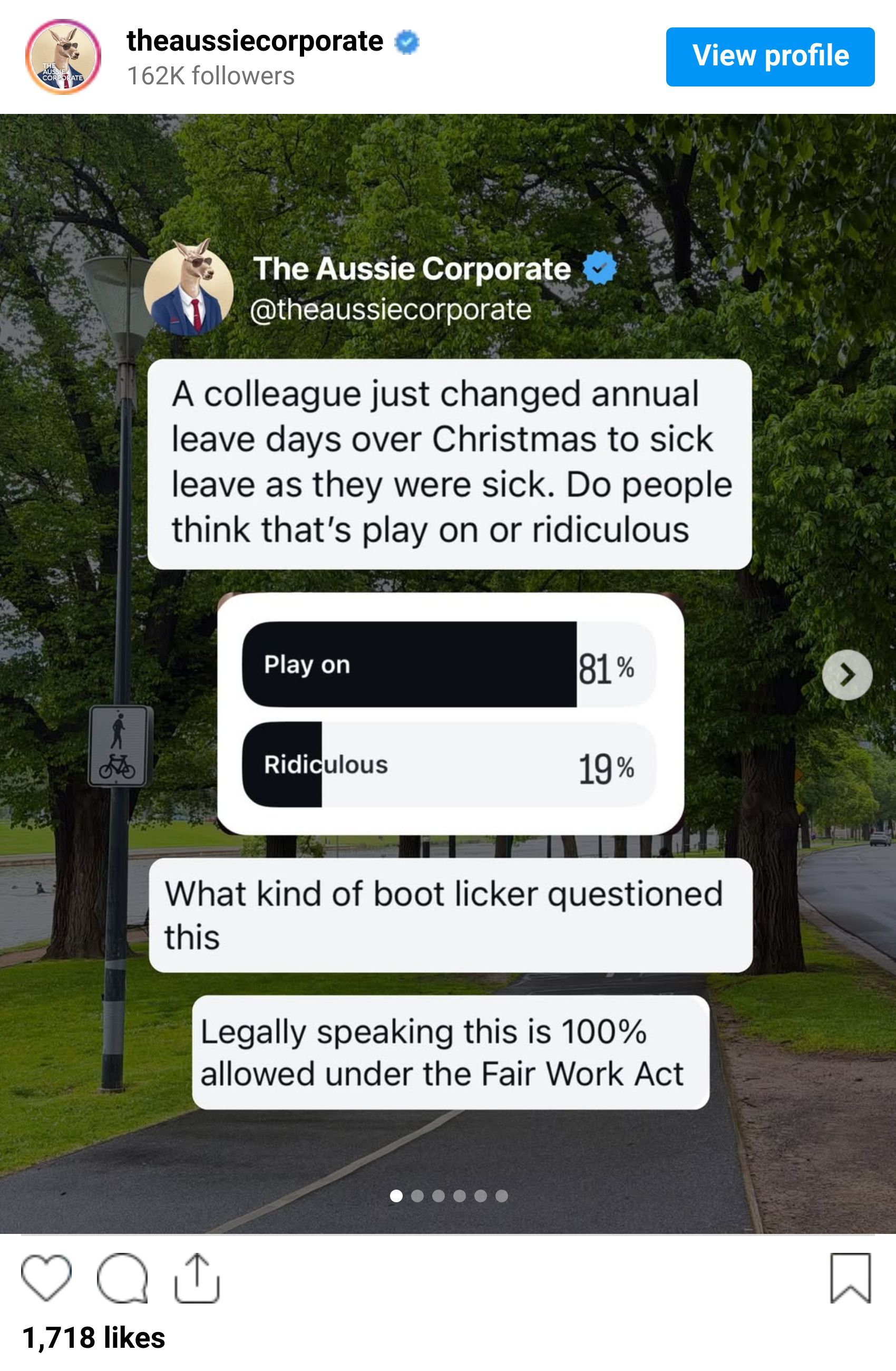
Where it gets tricky isn’t the legality of it all, but rather the optics. Some people see it as completely reasonable. Others think it’s career-limiting, sets the wrong precedent, or opens the door to misuse. We had more than one comment talking about it being a dangerous precedent for Gen Z employees. And while it might be lawful on paper, most of us know there’s a difference between being genuinely sick on leave and submitting four days of sick leave from Japan during ski season. Same rule, very different reaction.
What we heard most was that it’s highly firm-dependent - despite it being something that’s legally allowed (like the right to disconnect law…). Some managers encourage it and see it as basic fairness. Others quietly note it and move on. A few don’t forget it at all. That’s not right or wrong, it’s just how workplaces work unfortunately.
So consider this a quiet PSA, just don’t be the reason this gets tightened for everyone else.
3. Should someone working regional be paid the same as someone in Sydney?
The general view has been no. Pay has always reflected cost of living and market dynamics, and location still plays a role. The same way you wouldn’t pay an outsourced role overseas an Australian salary, it’s expected that working in places like Sydney, London or New York comes with higher pay because it simply costs more to live and work there. Think of it as a premium, similar to the extra loading applied to a casual role.
There’s also the competition factor. In major cities, you’re competing against a much deeper talent pool for the same role. In regional areas, the market is smaller and demand is different, which naturally pushes salaries down. Less competition usually means lower pay.
What often gets missed is that city roles also tend to come with faster career progression. Bigger clients, more stakeholders, more scrutiny, more internal competition. You’re not just paid for the job, you’re paid for the exposure and optionality that comes with it. Same title on paper doesn’t always mean that the work or the pressure is actually the same.
That said, not everyone agrees. Some pointed out that regional cost of living isn’t cheap anymore and can be comparable once everything is factored in. Others raised the “same role, same pay” argument, which we see in government and heavily standardised organisations. Where pay is flattened however, we often see talent thinning out and output dropping in CBD areas.
While the market does pay regional premiums when skills are genuinely scarce (mining towns, healthcare, specialised engineering), a reminder that pay isn’t just about fairness in isolation, but incentives, scarcity and where the work actually sits.
POWERED BY

How are Aussie corporates and other university students staying up to date with business news?
Pick & Scroll is our go-to daily morning news source for your top picks across Australian business, global and company news.
📊 AMP’S FINEST
2026 has opened with a sharp reminder that US policy direction still sets the global tone. Trump’s renewed America First approach, from foreign policy brinkmanship to pressure on long-standing alliances, hasn’t triggered immediate market panic, but it has reinforced a clear message - the US is increasingly willing to act alone and rewrite the rules if it suits domestic interests.

The consequence has been a shift in how investors think about risk. Confidence in the US as the default safe haven has softened, reflected in a sustained fall in the US dollar and renewed demand for alternatives like gold and silver. This hasn’t been about one headline or one decision, but rather a growing discomfort centred around unpredictability.
Markets have stayed surprisingly calm, but not indifferent. Capital is being reallocated rather than withdrawn, with investors hedging geopolitical risk while still backing growth where fundamentals hold up. Unless policy escalates into direct conflict or trade shocks deepen materially, the impact is likely to show up less as crashes and more as a slow repricing of what “safe” really means.
If that was helpful at all, you can listen to the AMP Econosights podcast here, featuring Shane Oliver, Diana Mousina and My Bui.
🗞️ ON YOUR MINDS
TOP AUSTRALIAN NEWS RECAP
A Melbourne worker has lost an unfair dismissal case while refusing a hybrid office policy, as the Fair Work Commission ruled the employer acted reasonably. LINK
The people with a higher salary than you and the jobs they work. LINK
Adelaide has become Australia’s top property investment city, outperforming the US tech market and all other cities in capital growth over 25 years. LINK
Need a new job? These are the top 10 skills Australian employers are looking for. LINK
A trend called "AI-maxxing" is seeing young people using artificial intelligence to automate daily tasks, chasing productivity and social credibility. LINK
THE ODD PICKS
Forbes has released their annual 30 Under 30 list. The Class of 2026 has raised an astronomical $3.8 billion in funding and amassed over 200 million followers on social media. LINK
Highly successful people do 3 things that many neglect, says Harvard career expert. LINK
Lego and Crocs have teamed up for an 'innovative partnership,' bringing brick shoes to your door. LINK
A youth retirement home designed for burnt out Gen Z and young millennials has popped up in Malaysia. LINK
Stop asking “How was school today?” to raise successful, mentally strong kids, ask these 7 questions instead. LINK
🗞️ UPCOMING BSOC EVENTS
O-Week 2026

Welcome to BSOC!🎢🎡
Feeling a mix of excitement and nerves on your first day? That’s totally normal, and we’re here to make it fun. Come meet us at the 💙 UNSW Business Society 💙, O-Week Stall! We bring the people, opportunities, and experiences that make uni unforgettable.
WHEN: 9th - 12th February 2026
WHERE: Alumni Lawn East, UNSW
TIME: 10am - 4pm
Peer Mentoring Program

✨ UNSW Business Society’s Peer Mentoring Program ✨ is BACK and ready to help you settle into university life with confidence, connection and support from day one! 🤝
The BSOC Peer Mentoring Program is the perfect way for first year Business students to:
Meet new people and build meaningful friendships 👫
Be guided by senior students through the ins and outs of the UNSW campus 🧭
Receive practical advice on university life, balancing coursework, extracurriculars, degree planning and more 🤓
Ask questions and gain support in a welcoming, friendly environment 🤔
Have fun while making the most of your first year 🥳
Uncharted Waters - First Year Orientation Camp 2026

CALLING ALL INCOMING FIRST-YEAR BUSINESS STUDENTS 📣 📣
Every year, UNSW BSOC hosts one of the largest orientation camps❗️ The transition from high school to university can be a daunting experience, however, our orientation camp is an inclusive and welcoming space 🤗 Whether you’re venturing out alone or with friends, this camp promises an exciting adventure for ALL 🏕️
WHEN: 20th - 22nd February 2026
WHERE: Douglas Park

Looking for something different to do on the weekends? We’ve got you covered with Puppy Yoga 🐶
Chatswood
Rhodes
Wynyard (Sydney CBD)
Mosman
Double Bay
Five Dock
Parramatta
Hurstville
Liverpool
Was this email forwarded to you? Sign up here